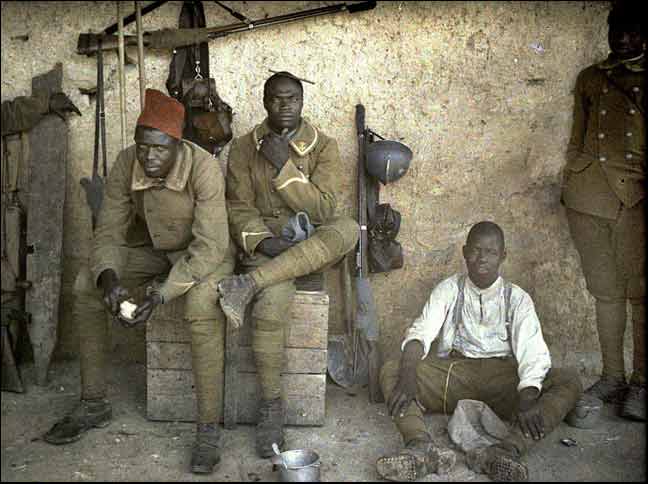
 | More North African soldiers In total the French colonies donated 587,000 soldiers to the warfare. Almost 520,000 of them fought on European soil. The Germans feared them.
Autochrome picture made by Jean-Baptiste Tournassoud. |
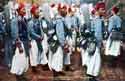 | Impetuous Algerians Algerian soldiers, nicknamed the Terrible Turcos.
The term Turcos was used not just voor people from Turkey, but also for North-Africans.
American picture (by photographers of the Underwood & Underwood Agency).
The original caption by this picture reads: "They are impetuous fighters, and the difficulty the French generals find in their employment is to hold them back at times when to charge the enemy is foolhardy." |
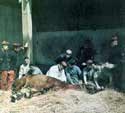 | Operating On A Horse The courtyard of a smithy serves as operating room for this French army horse.
Autochrome picture by Jean-Baptiste Tournassoud. |
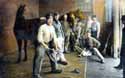 | A Neutral Horse A military shoeing-smith giving a horse a shoe.
The picture is made in the Netherlands, one of the few countries that stayed neutral during the Great War. However, the country had large contigents soldiers guarding the borders with Germany and German-occupied Belgium.
This beautiful postcard was send in 1918 by a Dutch soldier who served in an artillery division. The artillery used horses for pulling the guns. |
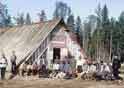 | Prisoners-Of-War in Russia Russian photographer Sergei Mikhailovich Prokudin-Gorskiipictured these Austrian prisoners-of-war in 1915 in the region of Karelia.
This is a true color picture, using a three-color separation system. |
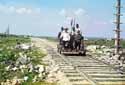 | Handcar Patrol on a handcar outside Petrozavodsk on the Murmansk railway, Russia, 1915.
The largest part of this railroad was built during the war by German Prisoners-Of-War. According to some reports so many POW's died that 'under every sleeper a German was buried'.
Another picture by photographer Sergei Mikhailovich Prokudin-Gorskii. |
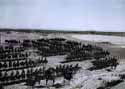 | Parade in the Desert The Australian Light Horse Brigade on parade in the desert, Palestine, 1918
A Paget Plate by Frank Hurley.
Hurley is best known for his Paget pictures of the 1914-1915 Shackleton expedition to the Antarctic (Hurley's most famous war picture is in black-and-white). |
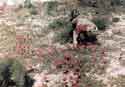 | Light Horseman Picking Flowers A soldier of the Australian Light Horse Brigade gathers anemones.
Palestine, 1918. Paget Plate by Frank Hurley. |
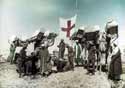 | Camel Ambulances Another picture by Frank Hurley.
Hurley photographed these ambulances of the Imperial Camel Corps in Rafa, on February 12, 1918. |
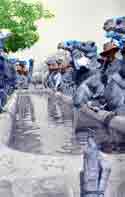 | Fresh Drink Welcome stop for the Imperial Camel Corps. |
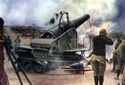 | The Sound of a Gun You can almost hear the sound of this French gun, photographed near Arras in Northern France. |
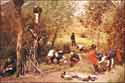 | Le Déjeuner sur l'Herbe It looks like a painting by impressionist Edouard Manet, but it is a real color picture, made in 1914,by Jean-Baptiste Tournassoud, Commander of the Photography and Cinematography Section of the French Army.
When the Great War broke out, in 1914, French poilu's (common soldiers) still wore uniforms with red trousers, dating from the middle half of the 19th century. They made perfect targets. |
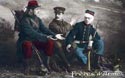 | Brothers in Arms Frères d'Armes, brothers in arms, is the text on this French postcard.
From left to right a Belgian soldier, a British soldier and a wounded French soldier. |
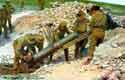 | Flying Pig Anzac soldiers (from Australia and New Zealand) are loading a trench mortar.
The picture was taken at Pozières, in Northern France.
The postcard was distributed by the Daily Mail in London, as part of a series of six pictures of Anzac forces.
The text on the backside reads: "Tommy's nickname for a trench-mortar is 'flying pig' and this picture shows some of our men loading one of these useful weapons". |
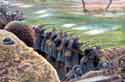 | Firing From A Trench German postcard with this text on the backside: Im Schützengraben Während eindes Schweren Gefechts: In the trenches during a heavy fight.
The postcard was send to a Fräulein in Dusseldorf, by a soldier who writes that he is happy to be away from the front for a couple of days. |
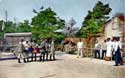 | Field Hospital A German Feld Lazaret (field hospital) in the Champagne area, in Northern France, 1916. |
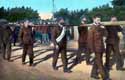 | Kriegsgefangenen German postcard published April 1915.
The text on the postcard reads: Kriegsgefangene Engländer bei der Arbeit.
Translated that is: English prisoners-of-war at work.
Over 170,000 British soldiers were taken prisoner by the Germans during the Great War.
Forced labour was not unusual for common soldiers who were taken prisoner.
The work on this picture does not appear to be very hard. One of the POW's is keeping one hand in his pocket. |
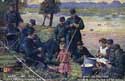 | Cooking For Soldiers Is this a photograph or a painting? Hard to tell, maybe a combination.
The postcard has a text, in French and in English, telling that a Belgian woman is cooking for the soldiers during a pause in the fighting.
The picture taken on the banks of the river Yser, in Western Flanders, Belgium. |
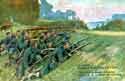 | Ambush From the same series. According to the text these soldiers are lying in ambush near the river Yser.
The postcard was send by a Belgian soldier, "with a thousand kisses", to his wife.
He also writes her that he tries to cure his headaches with asperine. |
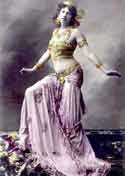 | Beautiful Mata Hari is known as one the most beautiful and intriguing spies in history.
She was Dutch and her real name was Greta Zelle. She was a dancer and had made this picture of herself to distribute among her admirers.
Ms. Zelle slipped into countless French and German beds, and became a pawn in international intrigue.
In 1917 she was convicted in France as a spy and executed. |
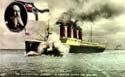 | Lusitania Torpedoed German postcard depicting the torpedoing of Lusitania.
This picture was faked.
The torpedoing arose so much anger in the United States and elsewhere, that from that moment on American participation in the war could not be avoided anymore.
In Germany the disaster was applauded as the public learned that the liner carried ammunition on board to England. |
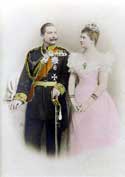 | Wilhelm und Auguste German emperor Wilhelm II and his wife Auguste Viktoria |
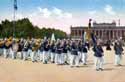 | Changing of the Guards in Berlin The German emperor loved ceremonies as much as his opponents.
The changing of the guards in Berlin, several times a day, was always a spectacle. |
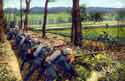 | Ready Another German postcard. According to the text it shows a "trench near a border".
It does not say when or where the picture was taken, but as the trench and the trees all look untouched it was probably made just before, or in the beginning of the war. |